Showing posts with label clean energy. Show all posts

Thursday, October 29, 2015

America’s Cleanest and Dirtiest Energy State --- Washington State #1 for Clean Energy


America's Cleanest and Dirtiest Energy States
VIA https://modernize.com

America’s energy policy has been the subject of much recent debate: From the Pope’s public advocacy of environmental stewardship to the EPA’s toughened regulations on pollution from petroleum refineries, the sources that power our society have rarely been so widely scrutinized. Once regarded as a subject best left to the energy sector, the way we fuel our economy has proven its relevance for all citizens, both in America and across the globe.
For our team at Modernize, this subject seems particularly important. We’re dedicated to providing consumers information and opportunities related to one of clean energy’s most promising technologies: solar panels. Our primary interest is in helping individual readers to find environmentally friendly solar options that generate wallet-friendly savings in the long run.
But we’re also paying attention to how whole swaths of the American energy landscape operate. That’s where our project “America’s Cleanest and Dirtiest Energy States” comes in. If you want to know your state’s energy track record or find out which states are leading (and trailing) the push for renewables, you’re going to want to read what comes next.

Our Methodology

For this project, we went straight to the most authoritative source available on America’s energy realities. We gathered data from the U.S. Energy Information Administration (EIA), the federal agency responsible for tracking stats related to America’s energy production and consumption. Lucky for us, they’ve got data dating back to 1960 and as recent as 2013, so we took the long view on each state’s energy legacy. Our work engaged a range of subjects, from total energy production from renewable sources to carbon dioxide emissions over time. Take a look at what we found out:
 
Not Everything is Bigger in Texas…
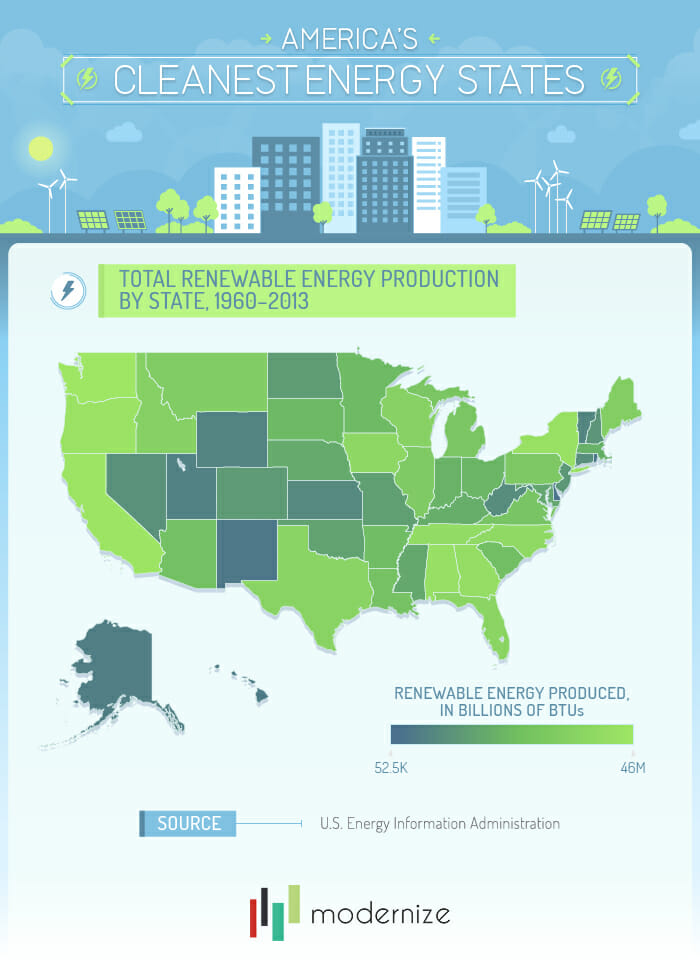
Renewable Energy Production by State
 
Let’s get something straight: “Renewable” energy sources run the gamut from hydropower to wind, solar, and more. The EIA includes biofuels, such as ethanol, in this category as well. That means that virtually any state can tap into renewables, though some types are more readily utilized in certain natural environments (for instance, the Midwest makes good use of its wind). But that also means oil- and coal-rich states like Texas and West Virginia have historically focused their efforts on sourcing energy from “fossil” fuels, so their output from renewables is relatively paltry.
To see each state’s exact numbers, check out the interactive map below:

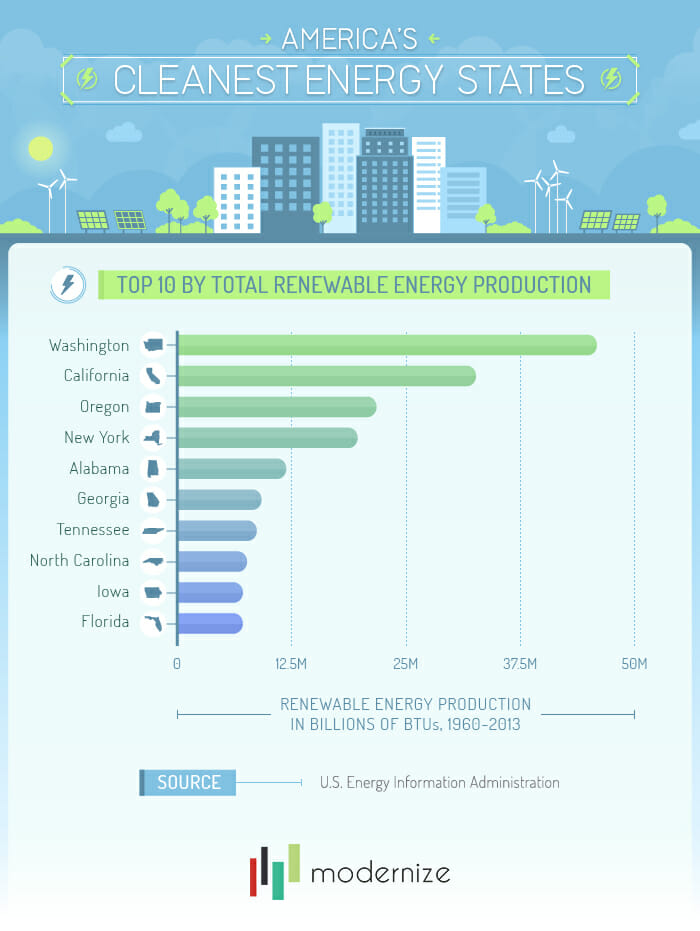
And here are the top 10 producers of total energy from renewables:
America's Cleanest Energy States

Maybe Washington, California, and Oregon come as no surprise – we associate them with environmental concern and the geographical variety to embrace multiple renewable technologies simultaneously. But the rest of the states that top the renewables ranking embody a striking mix of size, population, political preference, and socioeconomic standing. If this ranking indicates anything, it’s that success with renewables is possible in any combination of circumstances.

Power Percentages

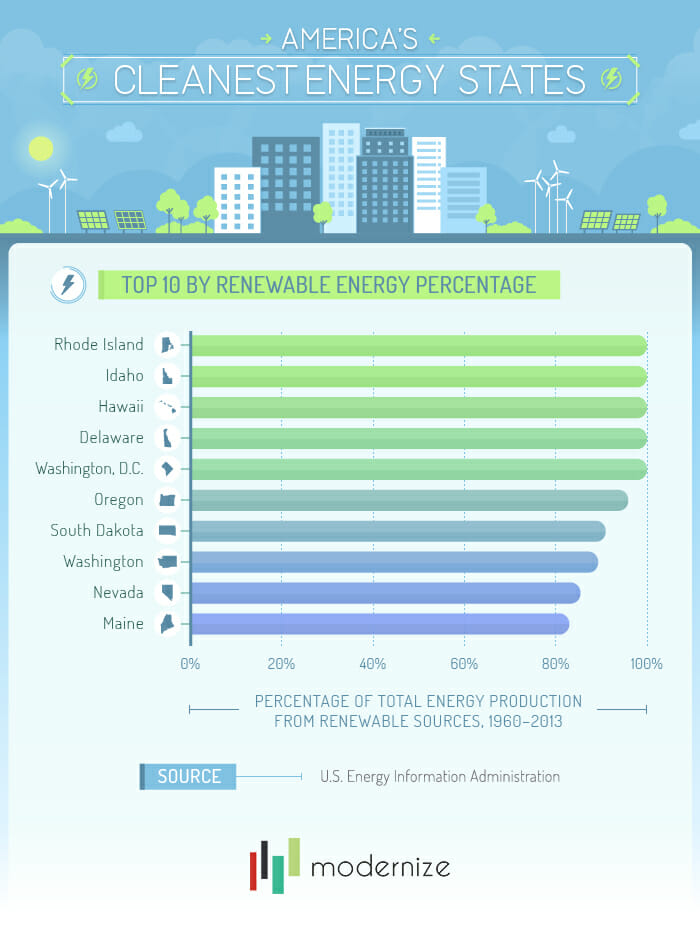
Now we know the score when it comes to the total volume of energy produced from renewables by state. But some states produce plenty of both, while others have pristine clean-energy records but fall short of the top 10 because their total production is too small to compete. So we also looked at how much of each state’s total energy production renewables account for – call these our Percentage Power Rankings:
Top 10 Renewable Energy States

Yes, you read that right: Rhode Island, Idaho, Hawaii, Delaware, and D.C. produce virtually all of their energy from renewable sources. Sure, that might be different if these states had been dealt a different hand in the distribution of natural resources (no one’s begging to drill outside Newport), but we can appreciate their commitment to renewable energy all the same. After all, necessity is the mother of invention – and as time goes on, more and more states may find themselves in need.
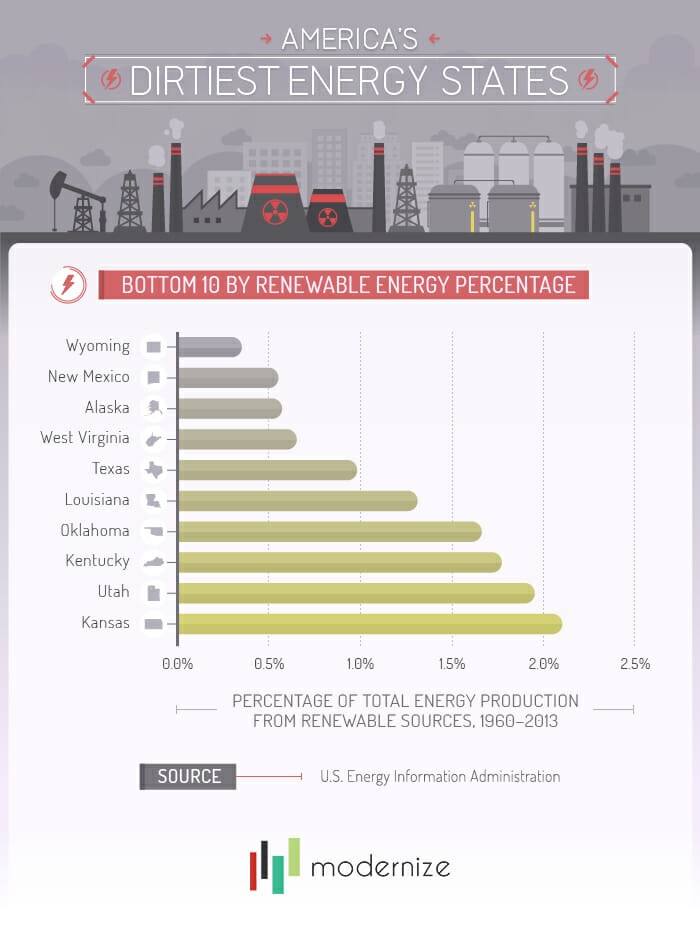
 
Americas Dirtiest States
Then there’s the cohort above, all of whom derived less than 2.5% of all the energy they produce from renewable sources from 1960–2013. The difference in reliance on renewables couldn’t be starker: Wyoming’s renewable portfolio accounts for roughly one in every 250 BTUs (British Thermal Units – oddly, no longer commonly used in the U.K.) that the state produces. Many of the constituents of this dirtiest energy ranking are too rich in coal and oil to need much in the way of renewable alternatives – but that doesn’t mean they won’t adopt more sustainable technologies in the coming years.

Pollution and Solutions

Perhaps the most concerning byproduct of fossil fuel energy production is pollution. That term covers many kinds of potentially harmful emissions, but the best-known variety is carbon dioxide. The EIA offers carbon dioxide data from 1990–2012, so we’ve tracked the worst emissions offenders over that time:
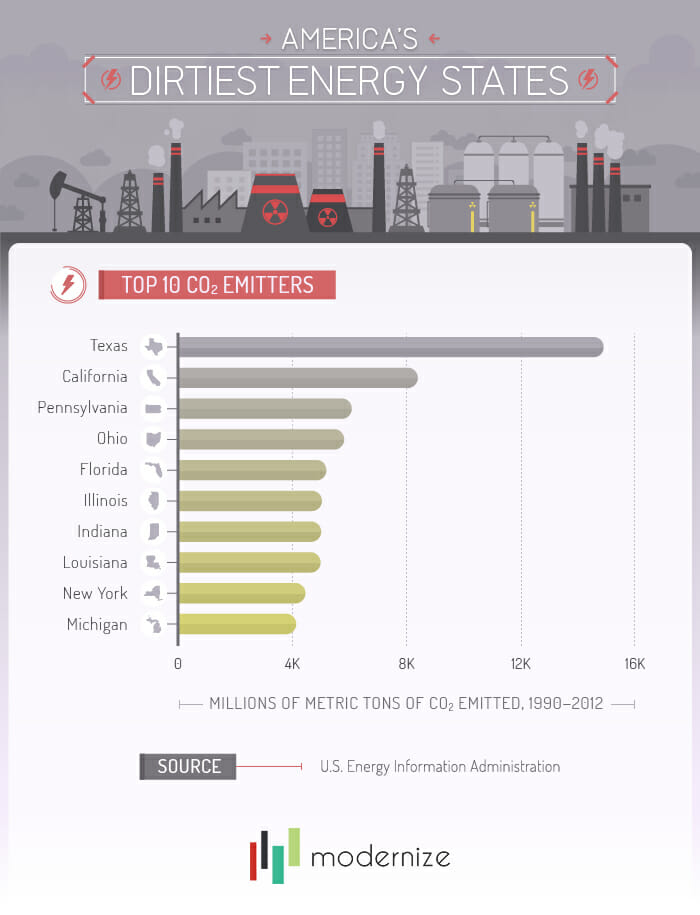
America's Top CO2 Emitter States
Predictably, Texas is at the top – but what about California or New York? Why do states that ranked high in renewable energy production make the list? The answer is simple: Carbon dioxide emissions aren’t just a function of energy production. It’s no accident that the top-ranked states are almost all quite populous; the more people, the more energy they consume. That translates to emissions resulting from cars, heat, and other comforts modern Americans depend upon in daily life. But don’t think emissions are an intransigent evil: Some states are making great strides.
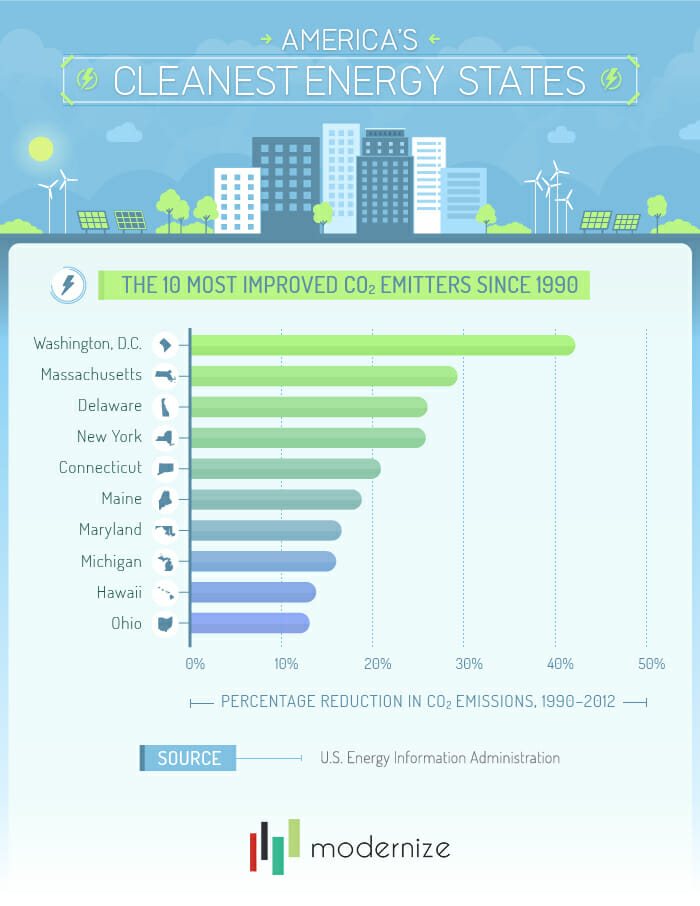
Americas Most Improved CO2 Emitter States
Let’s take a moment to commend these states for what they’ve accomplished in just 22 years. New York, Michigan, and Ohio are particularly exciting cases, demonstrating that even states closely associated with major industry can reduce emissions substantially. Additionally, some of the states that ranked high in the percentage of energy generated from renewables appear on this list, making it clear that improvement can always be a priority, whatever you accomplish for the environment.
Speaking of improvement, let’s remember that your own home can contribute to the pursuit of new, clean technologies, no matter which state you live in. Whether it’s turning off the light when you walk out of a room or researching solar options that will also create savings, you can do a lot to promote a cleaner energy world. Who knows? If you and enough of your neighbors make the right choices, your state might just jump up on our cleanest states ranking!

Monday, January 12, 2015

Solar Panel and Battery Combo Will Change The Energy Landscape

By: Katie Fehrenbacher
Originally posted in Gigaom


The big idea right now for solar and batteries is this: put solar panels on your roof, a battery in the backyard (or basement), and become utterly independent from the power grid, using free electricity from the sun. Batteries have long been looked to as a way to store energy solar energy during the day to be used at night, but they have long been too expensive to be used widely. But many companies are looking at 2015 as a very important year for the solar and battery partnership and I've heard the word “tipping point” being used repeatedly about this intersection recently.

Why all the excitement and why now? First off, traditional lithium-ion batteries — the kind being widely used in cell phones and laptops — are becoming cheaper than ever before. Electric car company Tesla and Japanese battery giant Panasonic have been working closely on lowering costs of their lithium-ion batteries significantly, and with Tesla’s “gigafactory” the companies expect to be able to reduce the lithium-ion battery cost by another third.


Marufish/Flickr


Navigant Research estimates that Tesla pays about $200 per kWh for its Panasonic battery cells today, and that price could drop as low as $130 per kWh by 2020 when Tesla’s massive factory — which is expected to more than double the world’s lithium-ion battery production — is fully up and running in Nevada. Several years ago, lithium-ion batteries cost closer to $1,000 per kWh. Tesla plans to sell some of the batteries from its factory into the power grid market, and SolarCity (the installer company chaired by Tesla CEO Elon Musk) already uses Tesla batteries for a solar panel energy storage system.


Lithium ion batteries are becoming such a clear low cost platform for energy storage that other startups beyond Tesla are adopting this idea, too. At CES last week, a startup called Gogoro launched an electric scooter and battery swapping infrastructure based around modular lithium ion batteries designed also in conjunction with Panasonic. Owners of the Gogoro scooter will some day be able to swap out their two depleted batteries at a nearby battery swap station, and they will likely pay a subscription for access to the batteries.


Gogoro’s electric scooter and battery station


But it’s not just the economics of lithium ion batteries that are driving the pairing of solar and batteries. Other startups have been developing newer, low-cost battery chemistries that are optimized for the power grid, like Aquion Energy and Ambri. Aquion Energy last week announced that one of its largest battery installations to date (2 MWh) is going into a solar system on the Kona coast of Hawaii.


The surge in solar panel installations is one of the main drivers behind this grid battery trend. There’s a lot bigger market these days for solar: More than a third of all new electricity installed in the U.S. in the first three quarters of 2014 came from solar panels, both utility-scale solar and solar panels on residential rooftops. That’s second only to new natural gas plants.


Battery stacks and modules in Aquion Energy’s factory. Image courtesy of Katie Fehrenbacher, Gigaom.

Gigaom/Katie Fehrenbacher, Gigaom.


Solar companies, like SunPower, SolarCity, Sunrun and others, are doing deals with battery makers, looking to offer new services. Startup Stem, which uses distributed battery packs to work like virtual power plants, is working with Kyocera Solar.


Then there’s the grid battery market that’s being opened up by the state of California’s aggressive mandates for energy storage. California utilities are being asked to buy 1,325 megawatts of energy storage services by 2020, and utility Southern California Edison has already said it will buy 250 MW of energy storage systems. Part of SCE’s plans will be made up by a huge 100 MW battery plant from AES Energy Storage and a 85 MW contract from Stem.


Tesla’s image of its clean powered factory. Courtesy of Tesla.

Courtesy of Tesla.


So clearly, utilities aren’t worried about energy storage in general, because they will some day be major users of this technology. But in the short term, some are worried about so-called grid defections. If your solar panels and battery offer you all the electricity options you need, why do you need the utility?


However, according to a recent report from Moody’s, batteries and clean power are just still too expensive to be too threatening right now. Moody’s said that even with battery prices at $200 per kWh, and solar panels at $3.50 per watt, these technologies are “an order of magnitude too expensive to substitute for grid power.” Battery prices would have to be closer to $10 per kWh to $30 per kWh range to be cost competitive widely for the power grid, said Moody’s.


Those costs might be difficult for (most) residential customers to justify, but it could be a different story for commercial building owners. GTM Research says the market for solar panels paired with batteries will surpass $1 billion in annual revenue by 2018 (up from just $42 million last year), with collectively 318 MW of solar and storage capacity installed in the U.S. by that time. One in ten new commercial solar customers will opt for an energy storage addition by 2018, predicts GTM Research.


2015, a123, Abu Dhabi, ACWA, Adani, aes energy storage, Africa, Ann Kirkpatrick, Arizona, arizona corporation commission, arizona public service, asp, Audi, batteries,behind-the-meter, benefit stacking, Boeing, BP, Britain, brite energy,california, Carbon, carbon footprint, Caribbean, CarsAutosSolar, Catholics, Chevrolet, China, China solar, clean energy, Clean Power Plan, Climate, climate change, climate change. environment, climate change. wind power, coal, coda energy, commercial, community solar, Congressmen, costa rica, costa rica news, costa rica public schools, costa rica school system, Costa Rica To Inaugurate, decentralized, demand charges, distributed energy, distributed resources, DNV GL, Dominion North Carolina Power, Duke Energy, economic growth, Elon Musk, Emissions, Energy & Industry, energy efficiency, Energy Projects, energy storage, Energy Tax Incentives, Energy Trilemma, EPA, Ex-Im Bank, EXTREME ENERGY, Facebook, farm energy, finance, financing, first solar, Floating Solar Plant, Florida, forecasts, Fuel Cell, Gene Green, Generation, geothermal, Glasgow, Goldman Sachs, GOP, Governor Cuomo, graphene, Green Climate Fund, green costa rica, green energy, GREEN WORLD RISING, greenworldrising, Grid, helical robotics, Home Fuel Cell, Honda, hospital, Hundai, Hybrid Vehicle, Hydraulic, hydro, hydrogen, Hydrogen Filling Station, Hydrogen Refueling Station, Hydrogen Society, Hydrogen-powered, incentives, incentives. nowsolarwa, India, Indianapolis. airport, INDIEGOGO, install, Investment, IRC, Ivan Urlaub, Japan, jobs, Koch Brothers, Kyocera, Kyrsten Sinema, Latin America, legal, Leonardo DiCaprio, Lima Accord, Lockheed Martin, Louisiana, Low Oil Prices, Mars, Mercedes, Mexico, Mexico renewable, Mexico solar,micro grids, micro inverter, Microgrid, Middle East, military renewables, Mirai, Moapa, Morocco, NASA, Natural Disasters, NC Clean Energy Business Alliance, NC Solar, NCSEA, New York, north carolina,North Carolina solar, North Carolina Utilities Commission, now solar,now solar wa, NOW! HYDROGEN, nowhydrogen, nowsolarwa, Ohio renewable, Ohio solar, oil, OIL AND GAS, Orix, Paul McCullagh, Peru Solar, Poland, Pope Francis, PowerHybridsCar, Production Tax Credit, Protection 1, prweb, PTC, R-Grand Junction, rate hikes, rates, rebates, Regulation & Policy, renewable, renewable energy, Renewable energy Solar power Energy Wind power, Renewable Energy Agency, Renewables, residential, Richard Branson, robotics, Ron Barber, Russia solar, s, Sacramento, Saudi, sce, SDG&E, seekingalpha, Sen. Ray Scott, solar, solar cells, solar energy, solar farm, solar investment, Solar Leases, Solar Leasing, solar panel, solar panel plant, solar panels, solar plant, Solar Policy, solar power, solar PPA, Solar PV, solar rebates, solar Washington, Solar Washington State,solar-plus-storage, solarcity, Solutions, SRP, Statkraft, SunEdison, Sunflower Floating Solar Power Plant In Korea, Sunrise Powerlink, Supercapacitors, sustainable, Tampa Bay, tax, Tax Extenders, Technology, TechPHEVsMercedes-BenzElectric Cars, Terrorism, Texas Utilities, The Lima climate talks, The Motley Fool, Tokyo, Toyota, Transmission & Distribution, transmission and distribution, Tribes,tuscon electric power, U.S. tariffs,UAE, UK, Urban, US military, utilities, VC funding, Volkswagen, Västra Götaland, WA state solar rebate, Wall Street, warranty, water, Wind, wind energy, World Future Energy Summit, Zombie Apocalypse

NOW! SOLAR Interview.