Sunday, December 27, 2015

Congress Just Extended the PTC and ITC: What You Need to Know


VIA http://blog.rmi.org
BY: AUTHORS
Late last week, Congress passed a bill that extends the Production Tax Credit (PTC) and Investment Tax Credit (ITC) that have benefited wind and solar, respectively. This is big news for the U.S. renewable energy industry. According to Bloomberg New Energy Finance, the net result could be 37 gigawatts of new wind and solar capacity—a 56-percent boost to the industry over 5 years, catalyzing $73 billion in new investment, and enabling as many as 8 million more households to access clean, renewable, affordable energy. In exchange for the tax credit extension, Congress has lifted the 40-year ban on crude oil exports that began with the 1970s Oil Embargo Crisis.
Environmentalists and energy analysts (among others) are asking if this grand compromise is a good one. We think it is.
The costs of solar and wind power have been falling steadily and sharply for years. They are widely expected to become the cheapest way to generate power in the U.S. and most of the rest of the world by 2020, as reported by Bloomberg, Fortune, and U.S. News & World Report. But first we have to make it to 2020, and between here and there has been a potential “valley of death” as incentives expired. The 10-year, $0.023/kWh PTC already expired at the end of 2014, and the wind industry went through another disastrous boom-and-bust cycle along with it. And the 30-percent solar ITC was set to drop significantly to 10 percent next year, with many industry players predicting a consequent crash in what has been a robust and rapidly-growing market.
But that has now changed.
In a display of bipartisan compromise that has been vanishingly rare in recent years, Congress has agreed to extend the solar ITC at the current 30-percent rate through 2019, after which it will fall to 26 percent in 2020, 22 percent in 2021, and 10 percent in 2022. An additional commence-construction clause will extend the credit to any project in development before 2024. And the wind PTC will be retroactively applied to 2015 and extended through 2016, after which it will decline each year until it fully expires in 2020.
Here are the key outcomes.
1. The extension gives wind and solar time to achieve parity (or better) with conventional generation without subsidy.
According to Lazard’s Levelized Cost of Energy Analysis – Version 9.0, released in November, the LCOEs for wind and solar have fallen 61 percent and 82 percent, respectively, over the past six years. This puts unsubsidized best-in-class wind and solar on par with or better than new gas-fired generation already. With continued cost declines for both renewable technologies, by the time the extensions expire after 2020, we expect that the tipping point will have been reached where wind and solar—beyond their best-in-class onshore and utility-scale versions—are firmly in place as the cheapest kilowatt-hours around.
2. Big corporations pursuing power purchase agreements (PPAs) for large off-site wind and solar transactions will continue to see competitive prices.
This year we have seen record-low PPAs for wind and solar projects, such as Austin Energy’s recent utility-scale solar procurement at less than 4 cents per kilowatt-hour and the best wind PPAs clocking in at 2.50 cents per kWh. The PTC and ITC ensure that renewables projects continue along their historical declining cost curve—the value of the extension goes beyond the current prices of these technologies; it's about maintaining their trajectories.
The PTC and ITC extensions are thus great news for the big corporations that have been driving significant capacity additions of renewable energy in the U.S., such as through the membership of RMI’s Business Renewables Center. They’ve signed deals for more than 3 GWof new large-scale, off-site renewable capacity this year, and we’re hopeful of an even stronger 2016 thanks to continued PPA price competitiveness. And it’s not just the Fortune 500 who’ll benefit. So will low-income customers, such as RMI is working with through eLab Leap, whether via utility-scale projects that contribute to a lower-cost grid, direct subscription via mechanisms such as community solar, or other solutions.
3. Because the PTC and ITC decline gradually over a period of years, the industry can plan accordingly, avoiding boom-and-bust cycles.
In previous years, the threat of PTC/ITC expiration (or their actual expiration, prior to renewal or extension) has resulted in major boom-and-bust cycles, such as for wind. But now, a predictable and gradual decline over a period of years gives both renewable energy industries clear glide paths to a post-subsidy era, similar to Germany’s deliberate step down of its feed-in tariff. Another five years under the PTC and ITC allows the wind and solar industries to continue cutting costs, innovating in finance, and preparing their project pipelines for the day when they can compete with the grid power incumbency totally unsubsidized.
4. Lifting the oil export ban is a small price to pay.
Many environmentalists and climate advocates have opposed lifting the 40-year-old ban on crude oil exports on the grounds that it would lead to greater carbon emissions. On balance, we believe (as does OPEC’s Secretary General) that lifting the ban will have negligible effects on emissions and commodities markets in what amounts to a zero-sum game. Lifting the ban will reduce the discount on U.S. oil relative to European grades, helping U.S. oil producers at the expense of U.S. refiners who have (until now) profited from that discount. Indeed, the spread between those benchmarks has nearly disappeared since the news of the omnibus budget deal broke. But as the ban was lifted, U.S. weekly imports of crude oil are at a two-year high as refiners seek cheaper crudes from Canada and overseas.
We do not see a significant expansion of U.S. oil production as a result of the ban being lifted. But the PTC and ITC extensions amount to a guarantee that the wind and solar industries will survive and thrive until they can fully stand and compete successfully on their own against the fossil fuel and nuclear incumbencies without any subsidies whatsoever. This is a watershed moment for renewable energy.

Saturday, December 26, 2015

Frank Capra’s Science Film The Unchained Goddess Warns of Climate Change in 1958


This film by Frank Capra: Frank Capra co-wrote the script for the film, and he was no liberal. He was a conservative Republican, who strongly opposed F.D.R. and celebrated American individualism. But Capra studied chemical engineering at Caltech and put stock in scientific research — before it became ideologically anathema to do that.
 One of the narrators declares:
Even now, man may be unwittingly changing the world’s climate through the waste products of its civilization. Due to our releases in factories and automobiles every year of more than six billion tons of carbon dioxide, which helps the air absorb heat from the sun, our atmosphere may be getting warmer.
And is that bad, the question gets asked?:
Well, it’s been calculated a few degrees rise in the Earth’s temperature would melt the polar ice caps. And if this happens, an inland sea would fill a good portion of the Mississippi valley. Tourists in glass bottom boats would be viewing the drowned towers of Miami through 150 feet of tropical water. For in weather, we’re not only dealing with forces of a far greater variety than even the atomic physicist encounters, but with life itself.
I don't want to spoil it but scientist were very aware of our impact on climate in 1958. 


Tuesday, December 22, 2015

Now That Climate Change Science Is Accepted, What's Next?

By: Eugene Wilkie


I have been following this climate change controversy quite closely for years as I own renewable interests and it seems to play a factor in our ability to finance renewable projects and products. I do not have any special interest or scientific training in climatology or atmospheric conditions or what effects them. What I do have that seems to be lacking in public forums is common sense. Common sense, if I fill my house up with smoke I can't breath and if left unchecked could eliminate any life left in my house. The same could be said for a natural gas leak in a home. Yes I know there are many other mitigating factors as far as the planet goes as it does have its own filtration system. I will leave that for the scientist to evaluate and expound on.

It seems the world has come together to admit we have a critical problem that has to be addressed NOW concerning the state and condition of our climate. So what is on the horizon and how do we get there for our country.

We are much more advanced in the progress of mitigating emissions then a lot of folks admit. Look at the amount of funds and schools that have divested from fossil fuel. Check out the stats for the amount of renewables currently installed. My point is I hear loud and clear from the fossil industry they know their days are numbered. I really think it is the reason we are seeing the clown act in the Presidential race as fossil is forcing their agenda on a party that does not seem to realize that the American people and the world for that matter, have spoken. It is rare for a politician to have a such a gem at their finger tips that could launch them into spot lights they never considered. That gem is everyone agrees they support renewables and are getting fed up with industry buying their vote. It would be a tough spot for any political party to not be able to use a fact that the people want but are unable to use it as a platform as the apposing industry owns you.

Think about this folks there is a political party owned by a dying industry who HAS to vote that party line. So if all the voters in your party have decided that we need to change directions drastically for the good of our country but you are running under a platform that does not support the requested change what are your chances. You can't run enough ads in the world to propaganda your way out of that one.

I read an article recently that questioned why the Democrat Candidates did not talk about climate or renewables. I will tell you why. It is the big gun that is going to lose Republicans a huge amount of support. This is not good. We the people need the checks and balances of both parties having representation.

I do not promote or recommend any political party as I do business with all. I support any political agenda that promotes the well being of the nation and the safety of our people. Supposedly our government was set up to protect and serve. How can you tell me you are protecting and serving me when we are fighting wars who's roots are founded in the fossil industry and that is your main financial instrument getting your seat in the political arena. That is only the tip of the iceberg of the unchecked corruption that has sprung from this seemingly endless amount of money generated in part largely due to subsidies fossils receive. So In a way they are using your money to manipulate government policy. BOTH PARTIES ARE GUILTY ON THIS COUNT. IS it the governments job to protect capitalism or its population as a whole. Our current system puts economics first. One needs to be financially strong to govern effectively right? The problem is those that are buying their vote are not paying taxes in the $billions and why? They bought the vote and get their right off. We need strong corporations. We need large capital generating companies. We need economy that provides employment for the masses.

The whole reason the founders set our government up this way was to have a healthy checks and balances system as it was a new experiment and they saw that it would need to change and grow. If business is now who makes government policies and the people have no vote in that checks and balances scenario we are screwed. Look at the damage we are dealing with right now from that. It will only get worse. I have to say I do not want my industry controlling the government either. You are locking your self out of innovations by taking sides with any industry.

Saturday, December 19, 2015

Elon Musk Is Changing The World More Than You Realize

Elon Musk Is Changing The World More Than You Realize

By Eugene Wilkie  VIA: www.linkedin.com

Elon Musk has intrigued me since he first popped up in the solar market.  He seems to be able to view the world from a perspective as one place with many different market opportunities.  I have never been a fan of complicated financial models.  The early movers like Elon Musk and Jigar Shah developed models that were making money on money.  It was one of the first times solar energy could be billed as the primary product when the real moneymaker was the financing mechanisms behind it.

In my companies, I have always tried to present and push a cash buy as the economics stay in the consumer’s pocket.  Nonetheless, both Elon Musk and Jigar Shah busted open the solar markets with their lease financial models.  If it had not been for them showing the financial community the earnings that were available, we probably would not have emerged as the legitimate industry we are today.  I know that Elon Musk has many more business endeavors, but I am just focusing on my known industry involvements.

Elon Musk and Jigar Shah are not the only ones, but they are the front-runners in my mind as they have developed legacies that have included moving forward to bigger and better.  I have nothing but respect for both even if I do not agree with their financial models being the best option for the end consumer (it is good for the investors as it is long term income).  It is true that it was almost impossible back in the day to get a solar loan, but that is not the case now.

Now that you have a little background on my view from the renewable sector of Elon Musk in my early days, I am going to explain why (from my point of view) Elon Musk could own Energy /Transportation.  Sun Edison, the company Jigar Shah founded, is also running neck and neck with Elon Musk in a new energy super model.

Often we can get tunnel vision when it comes to our particular industry and then it can be narrowed down to even smaller sub-sectors, for example, the energy industry has renewables.  In addition, there is the wind, solar, and hydro that are significant renewables.  Then in those emerging markets, like solar, you have many different models.  The obvious big difference with solar is that anyone can use it, unlike other power products.

My career has allowed me the opportunity in working in all renewable sectors although solar was my primary.  My early career was off-grid-power for places such as remote resorts in Latin America.  The reason I mention this is that I developed a model that was very effective.  First, one has to wipe out the fact that fossil fuel is available, but the customer wants all the enmities that are available to resorts fed with grid power.

I would first assess what their power needs were, both existing and expected growth, I would then look at the natural resources available and engineer/build a system that included golf carts that could be recharged for transportation.  Solar was very expensive back then, but I could show a great financial model even then with the amount they were spending on fossil fuel.  Some of the islands pay up to $15 a gallon for diesel.  I did incorporate wind, hydro and some geothermal but solar was the primary choice.

The reason I am telling you about my early career is that I realized early on to envision from a point of view of off grid, stripping all fossil fuel from the equation.  It is an eye-opening financial model especially when you compare it against fossil fuel at $10-15 a gallon.  That is in reality what gas would be if you stripped all their tax incentives and that is coming.  I have financial friends in the oil and gas industry, and they have told me they are preparing for this eventuality.

In my mind, there are three things in off grid to address energy, transportation, and communication.
If you look at where Elon Musk has spent his investments, it is in a holistic view of zero fossil fuel with fully integrated energy production/management and transportation.  Remember he also watched a market, solar, go from nothing to a major player, and a big part of that was a dramatic price reduction due to consumer demand because of access to financing.  Financing is no longer a problem in the market it just needs some maturity.  He is following that thought process into the energy storage sector.  When solar was first experiencing strong movement into the energy markets, there were more solar inventions than I could keep up with but in reality, it was bringing known technology prices down that sparked a fire in solar.

Think about this, he could sell you an entire energy production/management transportation package in one integrated product.  Your solar system has energy management (storage included) it provides your power and fuel for your car that can communicate with your production, and the fact is the batteries in your car when not in use is part of your residents energy storage system.  The excess energy produced by your solar system offsets the cost of recharging your Tesla on the road.  When the cost of fuel is removed from the equation of energy and transportations, the ability to integrate more functions into one package substantially increases.

Elon Musk's huge manufacturing of batteries factory is a great example of mass manufacturing bringing down prices of known technologies.  Think about this for a moment.  Once there is an established market all these young folks entering into the field are seeing opportunities to make their mark and huge potential earnings.  Therefore, if you already have established yourself as the biggest and best whom are they going to seek out?

I have no less than five new inventions or idea presented to me a month, and some of them are astounding.  I cannot imagine what Elon Musk has been presented with and what he knows is coming.  I have watched this many times with solar technology.  Someone has a great innovation; they first go out to raise funding, start their company, and then sell to someone with more longevity and financial stability in the market.  This same thought process can be spread across the spectrum of energy and transportation.

Elon Musk has addressed the total off grid picture, and that is the only way to dominance in this market.

I have seen ten different solar panels that have an inverter, charge controller (built in communication at the module level accessible by consumer and utility) and battery built in as part of the solar module.  I was impressed with the size of a few as I thought they would be bulkier, but it still needs a greater reduction in size and weight.

Think of it this way your cell phone used only to make calls and now, multi-functions have been integrated into the phone in a seemingly short period.  We will see models in complete form like this soon; it has already happened with the integration of micro-inverters and power optimizers into the actual model.  Just like the cell phone, the list is endless of all the features one could put into a total package.  Vertically integrated business models are difficult as you are bouncing more off internal data versus competition doing the same thing, but it can also be an advantage if managed right.
One needs to basically, own a bank as it is all projections and that is a hard check to cash.  Elon Musk has intimate experience in the financials of all these different components and if it can be made into one product, they will dominate several industries at once.  It is a brilliant idea.  Bring management of all components into one marketable product.  If I can afford a Tesla, I can afford the full package.

If current utilities are going to maintain their presence in the energy market, they need to prepare and change models.  It is probably too late for some.  The problem I have seen with some utilities that they are so indebted to fossil they cannot remove themselves from it.  That would be a real tough spot to be in as folks like Elon Musk and Jigar Shah (who have that Zero fossil fuel perspective) have and are developing sophisticated models that are less cost and offer way more advantages to the consumer in one product.  It will be that management software, which really will be the long-term residual generator.  One has to keep updating hardware and software right.

We are working with some local utilities, and they are preparing themselves for power management models.  Very Smart! I like to remind folks that change can be scary but going broke while watching others prosper is a horrible option.  In the military my commander used to tell us to adapt and change to the circumstances, we were experiencing ( actually went like this Adapt and change you %$@#@$%'s or I'm gonna beat your %$@# @$$ before it kills your @$$) . It rings true in all sectors of my life.

Wednesday, December 16, 2015

HUGE WIN SOLAR and WIND! Congress Agrees To Extend Solar And Wind Tax Incentive.

Member of Absolute Power Inc. hard at work.
By: Eugene Wilkie

"House Republicans unveiled legislation late Tuesday night that included multi-year extensions of tax credits for solar and wind." 

I swear I could hear a collective release of held breath when the news was announced that Congress had included extending the solar tax credit. I really like the fact that it was negotiation of a commodity that is our direct competition. Fossil fuel wanted something and the renewable industry used it as an opportunity to negotiate.

This will have tremendous positive consequences  for the wind and solar industry. It is up to the industry to take this moment and and use it to set ourselves up to make this industry sustainable even in the face of no incentives. We are very close and it CAN be done. 

For full article go to greentechmedia.com

[Excerpt] The credit extensions were attached to a broad set of spending measures as part of a negotiation with Democrats over lifting the ban on exports of U.S. crude oil.

Rhone Resch, president of the Solar Energy Industries Association, predicted in November that solar tax credits would likely be added to any deal around lifting the oil export ban. He called it "our best opportunity."

This month, Republicans demanded an end to the 40-year-old ban as part of a legislative tax and spending package that would fund the government through next fall.Although many Democrats oppose ending the ban, they saw it as an opportunity to demand extensions of the Investment Tax Credit (ITC) for solar and the Production Tax Credit (PTC) for wind.

Yesterday afternoon, Democratic leaders said they would only support the Republican proposal if renewable energy credits were added to a tax or spending bill.

The PTC -- a 10-year, 2.3-cent per kilowatt-hour credit -- would be extended through 2020. After December of 2016, the credit would be cut each year until it fully expired in 2020.

The ITC -- a 30 percent credit for utility, commercial and rooftop solar installations -- would get phased down through 2022. The credit would stay at 30 percent through 2019, and then fall to 26 percent in 2020. It would drop to 22 percent in 2021 and 10 percent in 2022. The bill also offers a commence-construction clause that would extend the credit to any project in development before 2024.

Hang on folks your about to see a industry that has been growing at unprecedented rates grow into one of the number one employment instruments in the U.S. if not world economy.

Tuesday, December 8, 2015

The amazing camera that can see around corners (w/ video)

The amazing camera that can see around corners

It’s just your average corner, but a far from average camera. Credit: Gariepy et al./Heriott-Watt

VIA http://phys.org
December 8, 2015 by Claire Vallance, The Conversation

How can a person see around a blind corner? One answer is to develop X-ray vision. A more mundane approach is to use a mirror. But if neither are an option, a group of scientists led by Genevieve Gariepy have developed a state-of-the-art detector which, with some clever data processing techniques, can turn walls and floors into a "virtual mirror", giving the power to locate and track moving objects out of direct line of sight.


The shiny surface of a mirror works by reflecting from an at a well-defined angle towards your eye. Because light scattered from different points on the object is reflected at the same angle, your eye sees a clear image of the object. In contrast, a non-reflective surface scatters light randomly in all directions, and creates no clear image.
However, as the researchers at Heriot-Watt University and the University of Edinburgh recognised, there is a way to tease out information on the object even from apparently random scattered light. Their method, published in Nature Photonics, relies on laser range-finding technology, which measures the distance to an object based on the time it takes a pulse of light to travel to the object, scatter, and travel back to a detector.
In principle, the measurement is quite simple. A laser pulse is bounced off the floor and scatters in all directions. A small fraction of the laser light strikes the object, and the back-scattered light is recorded on a patch of floor – the "virtual mirror" – next to the spot the laser strikes. Because the speed of light is known and constant, by measuring the time interval between the start of the laser pulse and the scattered light reaching the patch of floor, the position of the object can be triangulated.


However, the devil is in the detail. The timing measurement needs to be accurate to within around 500 billionths of a second (5x10⁻⁷, or 500 nanoseconds), and the light levels that must be detected are extremely low. Overcoming both of these obstacles requires some serious laser and detector technology. The used for the timing measurement are just ten femtoseconds (100,000 billionths of a second, or 10-15) long, and each pixel in the ultra-sensitive "camera" (known as a single-pixel avalanche diode array, or SPAD) used to image the patch of floor is essentially an ultrafast stopwatch that records the arrival time of the scattered light pulse to within a few hundred billionths of a second.
The complications do not end there. Light scattered from the object of interest reaches the virtual mirror of the floor, but so does light scattered from every other object in the vicinity. The success of this technique requires that the two be separated, the "signal" of the hidden object from the background noise of everything else.
This is achieved by using the fact that the hidden object the device is trying to detect is moving, while other nearby objects are not. Because the moving object generates a signal in the virtual mirror that changes with time, it can be filtered from the constant background signal produced by the stationary objects of the surroundings.


Supplementary video. Credit: Nature Photonics/ Gariepy et al.

The final complication is that the timing measurement for scattered light arriving at a single point on the virtual mirror and recorded by a single pixel in the detector unfortunately doesn't locate the object to a single unique position. A similar time delay could result from objects located at any number of different positions located an appropriate distance from the virtual mirror.
While the timing data from a single pixel only locates the object to a range of positions, the range is different for each pixel. However, it turns out that there is only a single position at which the timing condition is satisfied simultaneously for all pixels, and this allows the object to be unambiguously identified from the background signals.

The amazing camera that can see around corners
Laser light fired at the floor is scattered in a spherical wave. It reflects from the hidden object and makes its way back to the SPAD detector, where the noisy data is processed to reveal the hidden object. Credit: Gariepy et al./Nature Photonics
The prototype camera system allows the object's position behind the wall to be localised to within a centimetre or two, and by making measurements every few seconds the camera can also detect the speed of a moving object. In contrast to previous methods, which required long times, the new method can track moving objects in real time. At present it's limited to locating objects up to 60cm away from the virtual mirror on the floor, but this should improve to around ten metres, as well as to more closely detect the shapes of hidden objects as well as their positions.
So while it's not quite as promising, or as convenient, as the science-fiction powers of X-ray vision, the study's authors note that the technology has interesting future applications in areas such as surveillance – to detect a moving person behind a wall, for example – or in car safety systems to detect incoming vehicles approaching around corners. More information: Genevieve Gariepy et al. Detection and tracking of moving objects hidden from view, Nature Photonics (2015). DOI: 10.1038/nphoton.2015.234


Read more at: http://phys.org/news/2015-12-amazing-camera-corners-video.html#jCp

Monday, December 7, 2015

Why it’s time for Congress to stand with solar

VIA Bloomberg Government

December 7, 2015 Yuri Horwitz
Bloomberg Government regularly publishes insights, opinion and best practices from our community of senior leaders and decision-makers. This column is written by Yuri Horwitz, Chief Executive Officer at Sol Systems. 

As world leaders converge on Paris to discuss climate change, there is a negotiation occurring in Washington, D.C., that may have a more tangible and immediate impact. In the next two weeks, Congress will decide whether or not to continue to support the solar industry, one of the fastest growing industries in the nation. At risk are more than 100,000 jobs, and inaction will slow one of the most promising economic revolutions this country has seen in the last half century.

With a tax extenders package on the horizon before year-end, Congress has the opportunity to keep solar on its growth trajectory through the extension of the investment tax credit (ITC), or wipe out the last decade of growth for an American success story.

The solar industry has its roots in America. American inventors Charles Fritt, Edward Weston, Nikola Tesla led the innovation of the technology. American scientists at Bell Labs and Western Electric helped commercialize solar in the 1950s. The American government and NASA helped drive efficiency of the technology during the space race.

In the decades since, American scientists, engineers and entrepreneurs have collectively built a power generation infrastructure that is revolutionary. It runs each minute of each hour in each day across every state in our country and emits no carbon, no particulate matter and no mercury. These pioneers were the foundational blocks for today’s $50 billion (and growing) industry that employs hundreds of thousands of people in almost every state in our nation, and many times that globally.

The ITC has spurred this industry to add workers nearly 20 times faster than the overall economy, accounting for 1.3 percent of all jobs created in the U.S. over the past year. It has helped drive industry growth of 1,000 percent, and drive down the costs of solar power by 50 percent, in the last five years. More than 8,000 companies now operate nationwide and employ over 174,000 Americans. That is more than Twitter, Apple, Facebook and Google combined.

The solar industry also provides long-term stability and value for the electricity grid and its customers. Its only fuel source is the sun. Solar production is local and this production varies little from year to year. This is why energy giants like Duke, NextEra, Sempra and Warren Buffet’s MidAmerican now own the vast majority of solar power plants in this country. This is why corporations like Amazon, Ikea, Walmart and Apple have increased their investment in solar by 183 percent just in the last four years.

Tax incentives like the ITC should be utilized intelligently to drive innovation and support emerging technologies that have a net benefit to society. They should be reduced and removed when such technologies have matured and are directly competitive.

In the next 10 years, we must replace billions of dollars of aging and inefficient energy infrastructure with new wind, solar and natural gas facilities. In the same timeframe, solar power costs will continue to decline and reach cost parity across the nation – as it already has in Hawaii and Puerto Rico, as well as emerging international markets such as Latin America. The federal ITC is the bridge that gets us there.

In 2008, we established our company, Sol Systems, as a vehicle to empower ourselves and others alongside us to make a concrete, lasting impact on our global environment through clean energy investments here in the United States.

Almost eight years and 50 employees later, we stand by that mission and have financed over 375 megawatts of solar energy through partnerships with utilities, banks and insurance companies. That is enough clean, renewable energy to provide electricity to 42,682 homes.

The ITC has been critical to that growth. An ITC extension will enable the technology to evolve and drive the industry to mature so that both can contribute more effectively to our energy future.

The solar industry was born in America, it employs and empowers Americans and it powers America. It is time to unleash its full potential.

This column does not necessarily reflect the opinions of Bloomberg Government. 

Sunday, November 29, 2015

Where Renewable Energy is Beating Fossil Fuels

Renewable energy is growing in the U.S., but that growth is concentrated into some very specific states.
http://www.fool.com/investing/general/2015/11/28/where-renewable-energy-is-beating-fossil-fuels.aspx
 BY: Travis Hoium  (TMFFlushDraw)                
Author Bio
Travis Hoium has been writing for fool.com since July 2010 and covers the solar industry, renewable energy, and gaming stocks among other things.

The U.S. is now installing more renewable energy power plants each year than fossil fuels and with costs continuing to come down the trend will likely pick up steam in the future. Old guard utilities like Southern Company (NYSE:SO) and Dominion Resources (NYSE:D) have even made the transition, investing billions in wind and solar projects of late.
But renewable energy isn't being installed evenly throughout the U.S. Midwestern states dominate the wind markets while the southwest and eastern U.S. dominate solar energy. Where is renewable energy really beating fossil fuel and why is it winning? A key lies in where resources are located.
Not all solar energy is created equal
We don't have coal mines or oil wells in every state in the U.S. because those fossil fuel resources aren't located everywhere. And while the sun does shine on every state it doesn't do so evenly.
You can see in the map below that solar potential is highest in the Southwestern states like California, Arizona, Nevada, and New Mexico.

Solar Resource
Those markets are driven by abundant sunshine for large and small solar installations alike, but the East Coast is a booming market as well, driven by high electricity prices and state incentives.
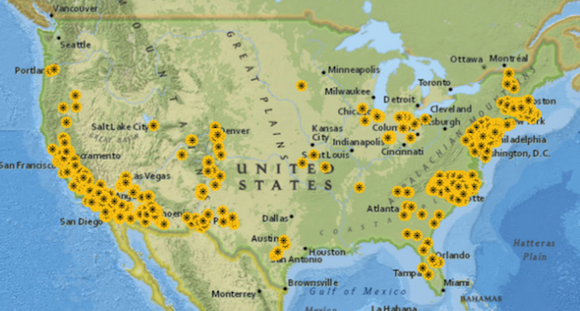
Us Solar Plants
Utilities have found ways to move where the resources are as well. Southern Company and Dominion are just two of a number of utilities buying solar projects through their unregulated arms, taking on long-term contracts to sell solar electricity to local utilities in California, Arizona, and elsewhere. It's a novel model that we can expect more utilities to pursue in coming years.
Solar energy isn't beating fossil fuel everywhere in the U.S., but where there's a combination of abundant sunshine, high electricity prices, and state willpower there's a booming market in the U.S.
Where the wind blows
The wind industry follows a similar dynamic to solar, making sense where the resource occurs naturally.
Wind Resource
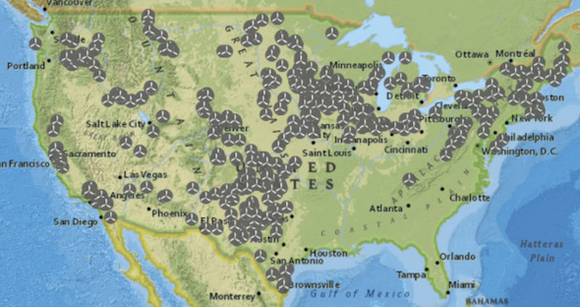
You can see that the Midwest down to Texas has abundant wind resource and that's where most of the wind turbines have been built. This is where Berkshire Hathaway's (NYSE:BRK-A)(NYSE:BRK-B) energy business began investing in renewables, building the largest wind fleet in the country. Since then it has taken ownership to the non-regulated side of the business like competitors, buying projects from wind and solar developers in states outside its home territory.
Us Wind Plants
There's also abundant unutilized resources offshore. That's where manufacturers GE and Siemens have spent a lot of money to develop innovative solutions, but so far with very little commercial successs.
Incredibly, most coastal states have more wind resource than even the windiest states inland. But there's not enough infrastructure to exploit offshore wind and there remains a hostile local opposition in most states working against offshore wind.
Renewable energy still has challenges ahead
The growth renewable energy has seen over the last decade has been impressive, but it hasn't been smooth. Costs have come down but until recently the industry has been reliant on tax incentives to drive adoption and as those incentives have ebbed and flowed (coming down along the way) these renewable resources have seen ups and downs.
The next two challenges will come from the solar investment tax credit declining from 30% to 10% in 2017 and rate changes being put forth by utilities themselves.
But with utilities like Dominion, Southern Company, and Berkshire Hathaway Energy taking a little less adversarial approach to renewable energy, even finding ways to turn it into a growth platform, there's a bright future ahead for renewable energy. It won't be everywhere in the country, but where there are resources available renewable energies are beating fossil fuels long-term

Tuesday, November 24, 2015

AMAZING! Just pedal for 1 hour to get 24 hours of home power


Creator of 5-hour Energy Wants to Power the World's Homes—With Bikes
The mystery man behind the popular caffeine shot plans to roll out 10,000 stationary bikes next year in India.

Picture of a man riding an electric bike
Manoj Bhargava, creator of the 5-hour Energy drink, demonstrates his Free Electric bike. By pedaling for one hour, he says, a person can power a home's lights and basic appliances for an entire day.

Image result for national geographic small logo png

By Wendy Koch, National Geographic


The man who created the 5-hour Energy drink says he has more money than he needs—about $4 billion more. So he’s giving it away, spending his fortune on a quest to fix the world's biggest problems, including energy. Manoj Bhargava has built a stationary bike to power the millions of homes worldwide that have little or zero electricity. Early next year in India, he plans to distribute 10,000 of his Free Electric battery-equipped bikes, which he says will keep lights and basic appliances going for an entire day with one hour of pedaling.
Bhargava, who dropped out of Princeton University after a year because he was bored and then lived in ashrams in his native India for 12 years, doesn’t stop at bikes. He’s working on ways to make saltwater drinkable, enhance circulation in the body, and secure limitless amounts of clean geothermal energy—via a graphene cord.
 
“If you have wealth, it’s a duty to help those who don’t,” says Michigan resident Bhargava, 62, in a documentary released Monday, Billions in Change, about his Stage 2 Innovations lab. “Make a difference in people’s lives,” he says, “Don’t just talk about it.”

Could his bike really work? Will people want to pedal for power? Could they afford it or even have room for it in their homes? It holds “huge potential and opportunity for rural households,” says Ajaita Shah, CEO of Frontier Markets, a company selling solar lamps and lighting kits in India. (Read about her work.) She says she’d like to test the bike with her rural customers.

“It’s so simple that we think we can make it for $100 … A bicycle repairman anywhere can fix it,” Bhargava says in an interview. Pedaling turns a turbine generator that creates electricity, stored in a battery. The first 50 bikes will be tested in 15 or 20 small villages in the northern state of Uttarakhand before a major rollout in the first quarter of next year. He says they’ll be made in India but doesn’t give details.


Who Is He?

Bhargava’s a bit of a mystery man. He grew up in an affluent home with servants in India, but his family struggled financially after coming to the United States when he was 14. He worked odd jobs and got academic scholarships. “It was worth a year,” he says of studying math at Princeton. After a spiritual quest in India, he built companies, including Living Essentials, maker of the popular two-ounce caffeine shot that’s sold at checkout counters.

Though generally low-profile, he’s not without controversy. He’s sued to fend off copycats of his blockbuster product and countered challenges from state attorneys general for alleged deceptive marketing. The Center for Public Integrity dubbed him the “political kingmaker nobody knows,” saying he’s donated millions to mostly GOP political candidates via limited liability companies.
Also unknown: exactly how much money he has. The documentary says his net worth is $4 billion, but Forbes does not list him among America’s richest 400 people, which includes those with at least $1.7 billion. Bhargava has said it’s difficult to put a specific valuation on his private companies, but he’s signed the Giving Pledge, a Bill Gates-led challenge for the rich to donate their fortunes to charitable causes.
 
He says he didn’t want to “ruin” his son by giving him money. “I told him when he was 10, 'You’re not getting anything.' His attitude: 'Great. I want to do it on my own,'” Bhargava says about his now adult son.
 
Instead Bhargava has funded hospitals in India and his cutting-edge Stage2 lab in Farmington Hills, Michigan, begun in 2011 with former Chrysler CEO Tom LaSorda. “It’s the most well-funded playhouse for engineers you can possibly have,” lab engineer Kevin Moran says in the documentary.
This is going to affect a few billion people.

Big Problems, Simple Fixes

Bhargava’s team has come up with innovative ideas in health, water, and energy. It’s pursuing Renew, a medical device that functions as an auxiliary heart by squeezing blood from the legs into the body’s core.
 
To address drought, it’s building the Rain Maker to convert 1,000 gallons an hour of any kind of water into drinkable water. Bhargava says potable water could be piped from offshore barges with this machine, now being tested at a desalination research facility in New Mexico.
 
He has an even grander idea—one aimed at nixing the world’s reliance on fossil fuels, which emit greenhouse gases when burned. Whatever people think of climate change, he says in the documentary, “pollution is a problem.” His answer: tap the heat from deep beneath the Earth.
 
While geothermal energy is already widely used in some countries, including Indonesia and Iceland, Bhargava takes a novel approach. Rather than using steam—mixed with chemicals—to bring the heat to the surface, he would instead pull it up with a graphene cord. He notes graphene, stronger than steel, is an incredible conductor of heat.
 
“You don’t need to burn anything…Once you bring [heat] up, you don’t change any of the infrastructure,” he says, explaining that utilities could simply distribute it instead of coal, oil, or natural gas.

“That’s going to be, in my mind, the final answer,” he says, estimating this type of geothermal could replace 85 percent of today’s fossil fuels. He says maps show half of the world has plentiful underground heat, and since graphene cables could run horizontally, they could route it to the other half as well.

“I think someone’s going to kill me,” he says with a laugh, noting how such an idea could upset geopolitics. He’s working with a graphene research center in Singapore to develop a cable and plans to have pictures available later this year.
"It’s not giving back. It’s what else am I going to do?"

The Bike Ridden Round the World?

Bhargava gets most animated when talking about his graphene cable, but he sees the most immediate potential in Free Electric. He says it could provide electricity for the developing world and offer post-storm backup power in wealthier countries.

Picture of an iPad charging via electric bike
The stationary Free Electric bike has a battery to store electricity generated when the rider is pedaling. Its monitor shows how much the battery is charged.


Monday, November 23, 2015

Underwater balloons give us a brilliant new way of storing renewable energy


Brilliant
DAVID NIELD     22 NOV 2015


While solar or wind farms are now contributing more energy than ever to the world's power supply, traditional energy sources are often required at peak times or to supplement renewable sources during dips in availability - at night, for example. So Canadian startup Hydrostor has invented a system of pressurised underwater balloons that can store renewable energy until it's needed, which could reduce the need for diesel or gas as a back-up source of power.
The company says its solution can last twice as long as the best batteries we have today, and at a much lower cost. The first facility has been set up in Lake Ontario near Toronto, with a series of balloons set 55 metres under the surface of the water and connected to the power grid via a pipeline.
"Compressed air's been around for 40 years," Hydrostor CEO Curtis VanWalleghem told Canadian Manufacturing. "It's finding places to store the air that's been the problem [and] why it hasn't been massively adopted. We open it up to thousands more sites because we use hydrostatic water pressure."
The material used by the underwater balloons - known technically as accumulators - is the same used to raise sunken ships from the ocean floor. Compressed air is at the heart of the system: excess energy is converted into compressed air via Hydrostor's proprietary technology, while heat generated by the process is stored as well through heat exchangers.
When required, the natural pressure of the lake is used to pump the air back to land, driving a turbine and generating electricity as it goes. The balloons in Lake Ontario are capable of holding enough energy to power 330 homes, and the developers of the system say it can be easily scaled up.
"We're now focused on commercialising this technology globally to bring our green energy storage solution to countries around the world," Vsaid VanWalleghem. "The G20 is talking about getting off fossil fuel by 2050. To do that, our electricity system has to incorporate storage so we don't need as much backup diesel and natural gas capacity - that's what this can do."
Here's how the system will work:


Should Residential Solar Pay A Utility Fee?

By: Eugene Wilkie

When we were first starting out in solar 20 something years back interconnecting solar to the utility was not an option. It was around 2000 that Sandia Labs really came out with interconnect design for solar inverters. Since then the ability to interconnect to the grid has grown in leaps and bounds from equipment side to regulations by utilities to allow net metering.

There have been many reasons that solar has enjoyed  this hockey stick growth model. Public education, net metering, huge cost reduction, and incentives are the main reasons for accelerated growth. I believe that the whole solar residential market owes its growth due to being allowed to interconnect to the utility so lets first define NET METERING.

This is the definition from SEIA or Solar Energy Industry Association.

Net Metering


Net metering allows residential and commercial customers who generate their own electricity from solar power to feed electricity they do not use back into the grid. Many states have passed net metering laws. In other states, utilities may offer net metering programs voluntarily or as a result of regulatory decisions. Differences between states' legislation and implementation mean that the benefits of net metering can vary widely for solar customers in different areas of the country.

What Is Net Metering?

Net metering is a billing mechanism that credits solar energy system owners for the electricity they add to the grid. For example, if a residential customer has a PV system on the home's rooftop, it may generate more electricity than the home uses during daylight hours. If the home is net-metered, the electricity meter will run backwards to provide a credit against what electricity is consumed at night or other periods where the home's electricity use exceeds the system's output. Customers are only billed for their "net" energy use. On average, only 20-40% of a solar energy system’s output ever goes into the grid. Exported solar electricity serves nearby customers’ loads.

This digital meter runs in both directions to accommodate electricity generated at this customer’s home.
A 4 kilowatt PV system on a home in this area would offset around 4911 kilowatt hours
of electricity each calendar year, saving the homeowner over $380 on their utility bill.
(Source – NREL PV Watts, EIA)
The way I explain it to our customers is that the grid is your battery and that you charge that battery during the day and withdraw from the storage at night. It is such a great storage system that you can over deposit during the summer then use it in the winter. In my experience with energy storage it is by far the most reliable and cost effective. Or one could look at it as a bank that you deposit savings into and withdraw when needed.

Just about every customer that we visit wants to have no power bills and emergency power with at least a five year return on investment. If I add batteries to completely disconnect from the grid the return on investment jumps up into the ten year ROI. I probably am working in solar in one of the most difficult markets, Washington State. The power is one of the cheapest energy markets in the US. We have an abundance of Natural Energy and we have been harvesting it since the 50's. We are selling a large amount of solar in this market due to NET METERING, LOCAL & STATE INCENTIVES, and of course the low cost of solar products. Yes we had to skinny up our margins but we are doing plenty of work to offset this.

Our average system that we sell cost around $33,000 that is using all the incentives which is around a 3-4 year return on investment or ROI. If I were to add a battery system and disconnect them from the grid or equal sized to their solar system it is another $33,000 and probably more. Our solar is warrantied for 25 years. Battery last 10 years adds huge replacement or maintenance cost. Yes we are hearing on the news every day the leaps that battery technology is making. I am in the market, pricing these storage systems and the economics are miles away from being financially viable for total offgrid.

The $33,000 solar system we sell is our smallest for the most part. So lets just do a comparison. If the utility charges you a meter fee of $25 a month it is $300 a year or $7500 for the 25 year life of the system. The storage system for the would be another $33,000 plus maintenance and 10-15 year replacement cost.

Our motto for years has been Why Rent Your Power When You Can Own It. I believe that even renting your storage still leaves the control for the most part in the customers hands. If one of our customers is still concerned about the ability to have autonomy during power outages we suggest a critical load back up battery system. Another words enough battery storage to handle some lights, fridge, and outlets to charge. We get a lot of request for this.
So lets talk about fairness. We know that the utility has a cost to at least upkeep the lines you are connected to as well as administration costs. The customer has just spent a huge amount of money (if they are owning not leasing) to get as close as possible to zero out their electricity bill. So who and how is responsible to offset the utilities cost? They have a customer still connected to their grid they HAVE to maintain but they are no longer making those great profits from the sell of power anymore.

If one were to just take the two previous points for utility cost versus solar customer is a very narrow view of the total benefits solar is providing to the utility and here is where it can get a bit complicated.

Lets start with this scenario. If you have a residential neighborhood of 20 houses and 10 of those houses installed solar. The power they produce is over what they are using in their house and is going onto the grid feeding the homes around it. About 20-40% of the power they are producing so realistically they are producing enough for 13-15 homes from the 10 with solar. So here is where it can be difficult as all utilities charge differently as far as TOU or time of use. For the most part utilities charge far more during PEAK HOURS which usually lasts from 7 AM to 7 PM or when everyone is using their power. We know that the energy over produced is used locally by neighbors. So the utility is not producing or shipping that power for three to five homes but they are collecting premium prices from non solar residents. Peak hour charges are about 30% of your bill. Yes you are buying the power back at night but that power is priced far below day time energy cost. 

So for example if your electricity rate during the day from Southern California it is $0.17 a KwH during peak hours or daytime and $0.09KwH at off peak or night. So they are charging the consumer that does not have the solar $0.17 you then buy your credited power at night for $0.09 a KwH. They are making a profit of $0.08 a KwH then wanting a fee from the original generator of the solar system. Remember they are not paying generation cost or transmission as the power is produced and used locally.

Lets just take for example one of our average systems of 7 kw. It produces 9,863 KwH in Washington State. So if 30% of that is Peak usage your personal peak usage is 2959 KwH leaving 6904 KwH the utility is selling to your neighbors at $0.17. If you calculate that by the profit they are making from selling your power and then discount your power charge at night for the $0.08 the utility makes it is $552 per year that they make. SCE or Southern California Edison has about 300,000 residential installs to date. If they were all our minimum size of 7 kw they would have profited $165,600,000.00

My point is this. For the most part utilities that have Time Of Use charging systems for electricity are profiting and at the same time returning to the trough for even more by adding a meter fee. Thier base power is usually provided with fossil fuel and they will probably tell you that they have to buy that power no matter what due to their contract they signed with that energy producer. So YOU the solar producer are being asked to once again subsidize fossil fuel and to add insult to injury it is coming from those investing in clean energy. But they are not the only ones that are attacking residential and small commercial solar.

There have been a group of very influential investors into large utility solar projects. Berkshire Hathaway and the Walmart family to name some of the bigger players. http://www.greentechmedia.com and http://ecowatch.com They can not sale you their solar power if you already have solar so they have spent a huge amount of money making false claims about the cost of residential solar to the utility to protect their investment.

Americans have stood up and the majority now support solar energy. We have the same old fossil and special interest wanting to keep it in Corporations pocket not the end user.


NOW! SOLAR Interview.